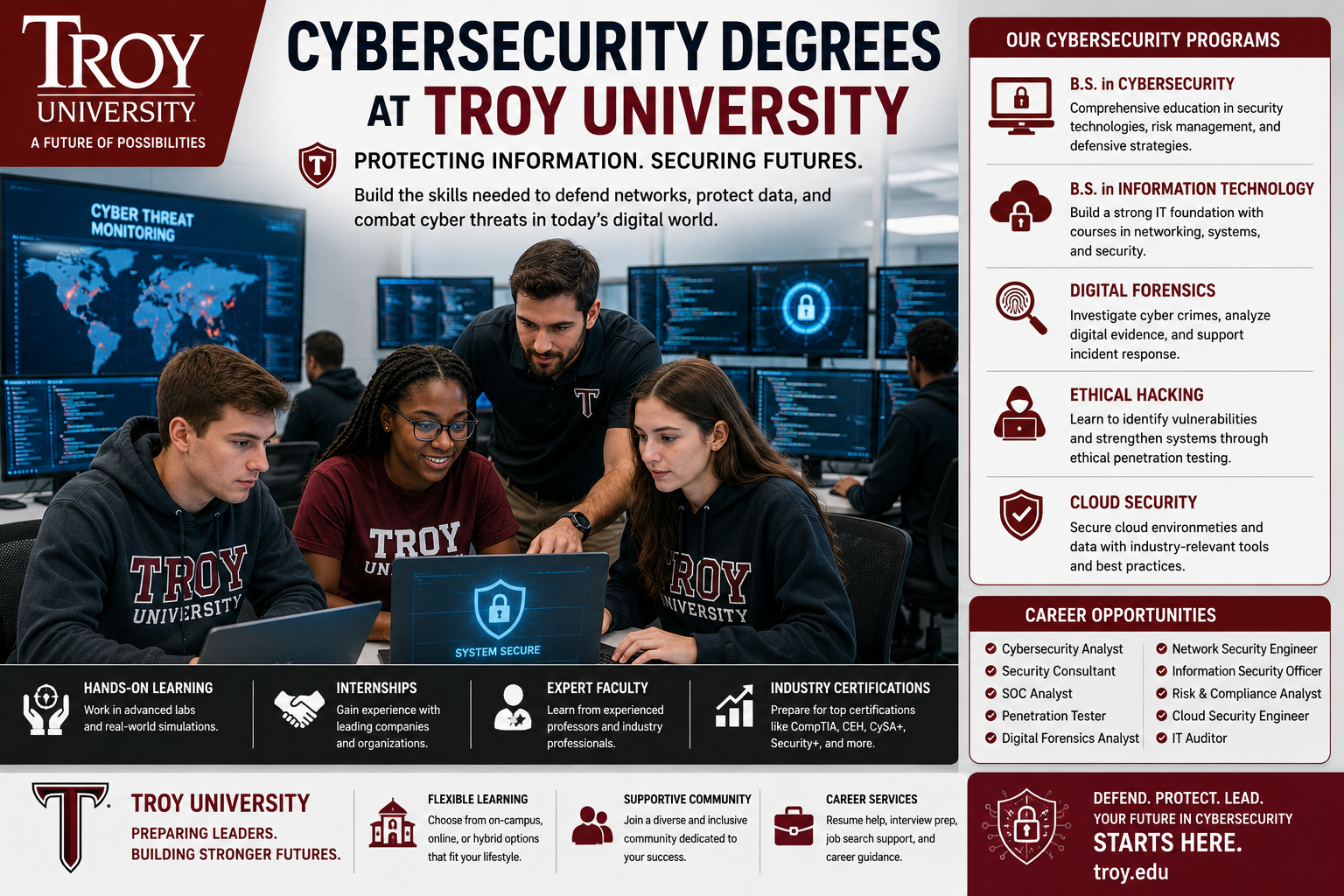

Cybersecurity Degrees at Troy University (2026), Cybersecurity has become one of the most important and fastest-growing career fields in the digital age. As businesses, governments, healthcare organizations, and financial institutions rely more on technology, protecting sensitive information from cyber threats has become a top priority. This growing demand has created thousands of career opportunities for skilled cybersecurity professionals.
If you’re considering a technology-focused education, Cybersecurity Degrees at Troy University can help prepare you for a rewarding career in information security, digital defense, and network protection. Troy University offers career-oriented programs that combine technical knowledge with practical experience, helping students develop the skills employers seek.
This guide explains everything you need to know about studying cybersecurity at Troy University, including available programs, coursework, career opportunities, internships, and future job prospects.
Why Choose Troy University?
Troy University has earned a reputation for providing practical, career-focused education across a wide range of disciplines, including technology and information systems.
Students benefit from:
- Career-oriented degree programs
- Experienced faculty
- Modern computer laboratories
- Flexible online and on-campus learning
- Affordable tuition
- Internship opportunities
- Career Services support
- Military-friendly education
These advantages help students prepare for today’s competitive technology job market.
Why Study Cybersecurity?
Cybersecurity professionals protect computer systems, networks, applications, and sensitive information from hackers, cyberattacks, and data breaches.
Organizations in nearly every industry need cybersecurity experts, including:
- Government agencies
- Healthcare providers
- Banks
- Technology companies
- Manufacturing businesses
- Educational institutions
- Retail companies
- Defense organizations
Because cyber threats continue to evolve, cybersecurity remains one of the most stable and in-demand career fields.
Cybersecurity-Related Programs
Students interested in cybersecurity often study technology-related programs that build strong technical foundations.
Coursework may include subjects such as:
- Information Technology
- Computer Science
- Cybersecurity
- Network Administration
- Information Systems
- Digital Forensics
- Cloud Computing
- Data Security
These programs combine theoretical knowledge with practical technical skills.
Core Subjects You Will Study
Cybersecurity students learn how to protect digital systems using modern security practices.
Common subjects include:
- Network Security
- Ethical Hacking
- Information Security
- Operating Systems
- Computer Networks
- Database Security
- Risk Management
- Cyber Law and Ethics
- Digital Forensics
- Security Policies
These courses help students understand how organizations defend against modern cyber threats.
Programming Skills
Programming plays an important role in cybersecurity.
Students may learn languages such as:
- Python
- Java
- C++
- SQL
- JavaScript
Programming knowledge helps cybersecurity professionals automate security tasks, analyze threats, and develop secure software.
Ethical Hacking
Ethical hacking teaches students how authorized security professionals identify vulnerabilities before cybercriminals can exploit them.
Students learn how to:
- Test system security
- Identify weaknesses
- Analyze vulnerabilities
- Improve network protection
- Strengthen cybersecurity defenses
Ethical hacking is widely used by organizations to improve digital security.
Digital Forensics
Digital Forensics focuses on investigating cyber incidents and recovering digital evidence.
Students explore:
- Incident response
- Evidence collection
- Malware analysis
- Cybercrime investigations
- Data recovery
- Security reporting
These skills are valuable in both public and private sectors.
Cloud Security
As organizations move data to cloud platforms, cloud security has become increasingly important.
Students may study:
- Cloud infrastructure
- Identity management
- Data encryption
- Access control
- Cloud risk management
- Secure cloud architecture
Cloud security specialists help organizations protect digital resources stored online.
Hands-On Learning
Troy University emphasizes practical learning to prepare students for professional careers.
Students often participate in:
- Computer laboratory exercises
- Security simulations
- Technical projects
- Team assignments
- Capstone projects
- Case studies
Hands-on experience allows students to apply classroom knowledge to real cybersecurity challenges.
Internship Opportunities
Internships provide valuable professional experience before graduation.
Cybersecurity students may find internship opportunities with:
- Government agencies
- Technology companies
- Financial institutions
- Healthcare organizations
- Defense contractors
- Private businesses
Internships strengthen resumes while helping students build professional networks.
Career Services
Troy University provides Career Services that support students throughout their job search.
Career support includes:
- Resume writing assistance
- Career counseling
- Interview preparation
- Internship guidance
- Employer networking
- Career fairs
- Job search resources
Students who use these services often feel better prepared for professional employment.
Career Opportunities
Graduates with cybersecurity knowledge can pursue careers such as:
- Cybersecurity Analyst
- Information Security Specialist
- Network Security Administrator
- Security Consultant
- Digital Forensics Investigator
- Risk Analyst
- Security Operations Center (SOC) Analyst
- Compliance Specialist
- Cloud Security Engineer
- IT Security Manager
Cybersecurity professionals work across nearly every industry because digital security is essential for modern organizations.
Salary Potential
Salary varies depending on:
- Job role
- Experience
- Industry
- Geographic location
- Technical certifications
- Employer
Cybersecurity careers generally offer competitive salaries, and professionals who earn industry certifications often improve their career opportunities.
Professional Certifications
Many employers value cybersecurity certifications alongside a university degree.
Popular certifications include:
- CompTIA Security+
- Certified Ethical Hacker (CEH)
- CompTIA CySA+
- CISSP (for experienced professionals)
- AWS Security Specialty
- Microsoft Security Certifications
Certifications demonstrate specialized knowledge and commitment to professional development.
Skills Employers Value
Successful cybersecurity professionals develop both technical and workplace skills.
Important abilities include:
- Critical thinking
- Problem-solving
- Communication
- Analytical reasoning
- Teamwork
- Attention to detail
- Adaptability
- Continuous learning
Technology changes rapidly, making lifelong learning an essential part of cybersecurity careers.
Admission Requirements
Admission requirements may vary depending on the program and applicant type.
Applicants generally need:
- Completed application
- Academic transcripts
- High school diploma or equivalent
- English language proficiency (for eligible international applicants)
- Required supporting documents
Students should review the latest admission requirements before applying.
Frequently Asked Questions
Is cybersecurity a good career?
Yes. Cybersecurity continues to be one of the fastest-growing technology fields due to increasing demand for professionals who can protect digital systems and sensitive information.
Does Troy University prepare students for cybersecurity careers?
Technology-related programs at Troy University provide students with technical knowledge, practical experience, and career support that can help prepare them for cybersecurity-related roles.
Are internships available?
Yes. Many students gain practical experience through internships with government agencies, technology companies, healthcare organizations, financial institutions, and other employers.
Can international students apply?
Yes. International students can apply if they meet Troy University’s admission and English language requirements.
Final Thoughts
Cybersecurity Degrees at Troy University provide students with valuable technical knowledge, practical learning opportunities, and career preparation for one of today’s most in-demand industries. Through coursework in network security, ethical hacking, cloud computing, digital forensics, and information security, students build a strong foundation for protecting modern digital systems.
Whether your goal is to become a cybersecurity analyst, security consultant, digital forensics investigator, or cloud security specialist, Troy University offers an educational environment that supports skill development, professional growth, and long-term career success.