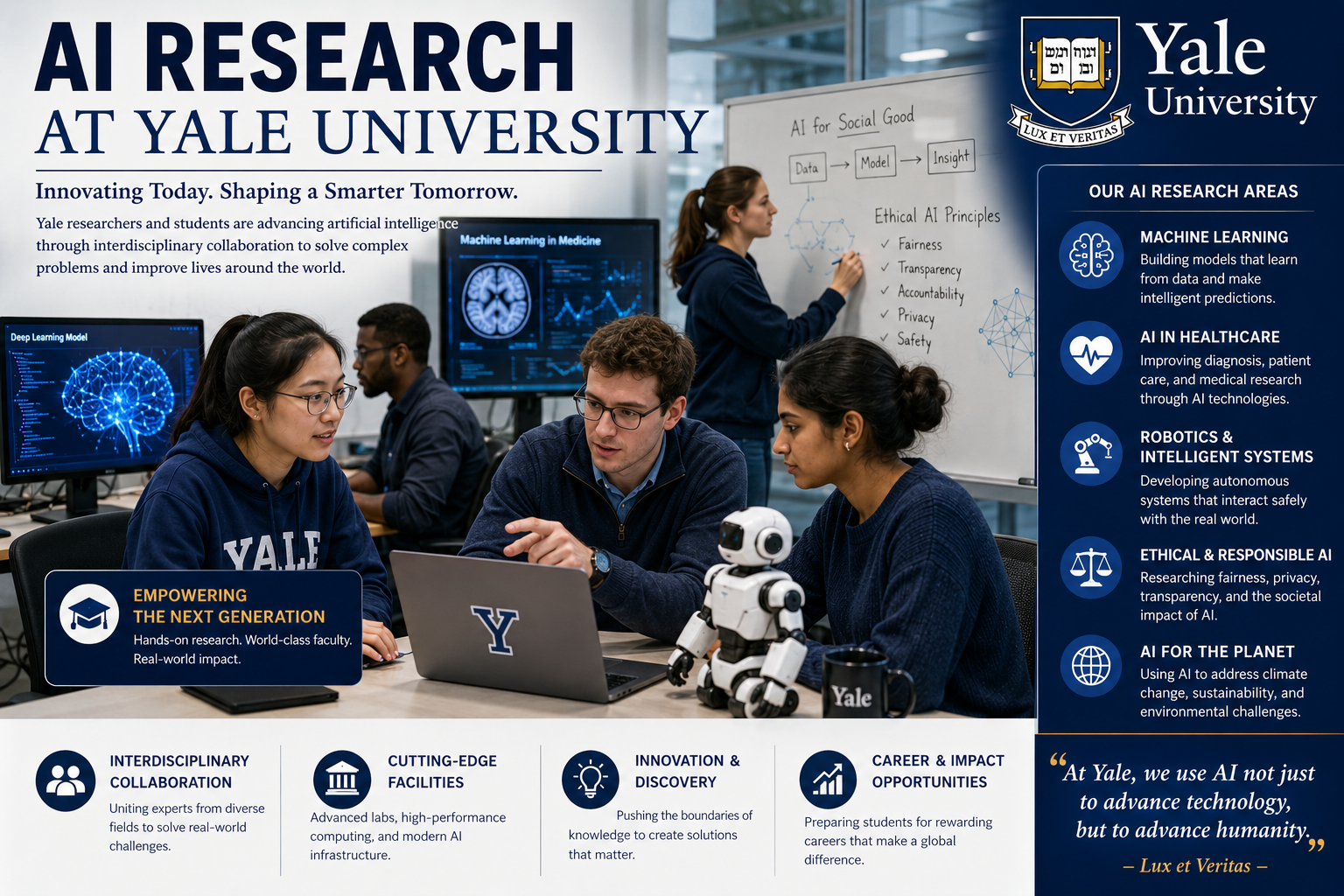

AI Research at Yale University (2026), Artificial Intelligence (AI) is reshaping industries, improving scientific research, and transforming the way people live and work. Universities around the world are investing in AI research to solve complex problems in healthcare, engineering, climate science, business, education, and many other fields. Among these institutions, Yale University has become an important contributor to interdisciplinary AI research through collaborations across science, medicine, engineering, public health, law, and the social sciences.
If you are interested in studying at a university that values innovation and cutting-edge research, understanding AI research at Yale University can help you see how students and researchers contribute to the future of artificial intelligence.
This guide explores Yale’s AI research environment, research opportunities, academic programs, career prospects, and how students can prepare for careers in one of the world’s fastest-growing technology fields.
Why Artificial Intelligence Matters
Artificial Intelligence enables computers to perform tasks that typically require human intelligence, such as learning from data, recognizing patterns, understanding language, and supporting decision-making.
AI technologies are widely used in:
- Healthcare
- Finance
- Cybersecurity
- Education
- Robotics
- Climate science
- Manufacturing
- Transportation
As AI applications continue to expand, universities play an essential role in developing new technologies while studying their ethical and societal impacts.
Why Yale University Is a Strong Place for AI Research
Yale University is internationally recognized for academic excellence and interdisciplinary collaboration. Rather than limiting AI research to one department, Yale encourages researchers from different fields to work together on complex challenges.
Students benefit from:
- World-class faculty
- Advanced research facilities
- Interdisciplinary collaboration
- Research-focused education
- Access to modern computing resources
- Graduate and undergraduate research opportunities
- Global academic partnerships
- Strong innovation culture
This collaborative approach allows AI research to address real-world problems across many disciplines.
AI Research Across Multiple Disciplines
One of Yale’s strengths is applying Artificial Intelligence to many different research areas.
Researchers explore AI in fields such as:
- Medicine
- Biology
- Computer Science
- Environmental Science
- Economics
- Law
- Public Health
- Psychology
This interdisciplinary approach encourages innovation by combining expertise from multiple academic departments.
Machine Learning Research
Machine Learning is one of the most active areas of AI research.
Researchers investigate methods that allow computers to learn from data and improve performance over time.
Areas of study include:
- Predictive modeling
- Data analysis
- Pattern recognition
- Deep learning
- Neural networks
- Computer vision
These technologies support applications ranging from medical diagnosis to scientific discovery.
AI in Healthcare
Healthcare is one of the most promising areas for Artificial Intelligence research.
AI can assist researchers and healthcare professionals by:
- Analyzing medical images
- Supporting disease prediction
- Improving patient care
- Accelerating medical research
- Assisting clinical decision-making
- Managing healthcare data
Yale researchers explore how AI can complement healthcare professionals while improving patient outcomes and research efficiency.
Robotics and Intelligent Systems
Artificial Intelligence also plays an important role in robotics.
Research areas may include:
- Intelligent automation
- Autonomous systems
- Human-computer interaction
- Computer vision
- Robotic decision-making
These technologies have applications in manufacturing, healthcare, transportation, and scientific research.
Ethical AI Research
As Artificial Intelligence becomes more powerful, responsible development is increasingly important.
Researchers examine questions related to:
- AI fairness
- Privacy
- Transparency
- Accountability
- Data security
- Responsible innovation
Studying the ethical implications of AI helps ensure that new technologies benefit society while reducing potential risks.
Student Research Opportunities
Yale encourages students to participate in research throughout their academic journey.
Students may have opportunities to:
- Assist faculty researchers
- Join laboratory projects
- Conduct independent research
- Participate in interdisciplinary collaborations
- Present research findings
- Attend academic conferences
Research experience helps students develop technical knowledge, critical thinking, and problem-solving skills.
Skills Developed Through AI Research
Students involved in AI-related research strengthen many valuable skills.
These include:
- Programming
- Data analysis
- Statistical reasoning
- Machine learning concepts
- Research methodology
- Scientific communication
- Team collaboration
- Critical thinking
These skills are valuable across technology, healthcare, finance, engineering, and research careers.
Career Opportunities After AI Research
Students with AI research experience may pursue careers in many industries.
Popular career paths include:
- AI Engineer
- Machine Learning Engineer
- Data Scientist
- Software Engineer
- Research Scientist
- Robotics Engineer
- Computer Vision Specialist
- AI Product Manager
Many graduates continue into doctoral programs or advanced research positions in academia and industry.
Future of AI at Yale University
Artificial Intelligence continues to evolve rapidly, and universities are expanding research efforts to address new opportunities and challenges.
Future areas of interest may include:
- Generative AI
- Responsible AI
- Healthcare innovation
- Climate modeling
- Scientific computing
- Human-centered AI
- Advanced robotics
Interdisciplinary collaboration will likely remain central to Yale’s research approach as AI technologies continue to develop.
Tips for Students Interested in AI
Students considering AI research can strengthen their preparation by:
- Learning programming languages such as Python.
- Studying mathematics and statistics.
- Building machine learning projects.
- Participating in research opportunities.
- Reading current AI research papers.
- Developing problem-solving skills.
- Staying informed about ethical AI issues.
Continuous learning is essential because Artificial Intelligence evolves quickly.
Frequently Asked Questions
Does Yale University conduct AI research?
Yes. Yale supports AI-related research across multiple disciplines, including computer science, medicine, public health, environmental science, economics, and other fields through interdisciplinary collaboration.
Can undergraduate students participate in research?
Yes. Many undergraduate students have opportunities to work with faculty members, participate in research projects, and gain hands-on research experience.
What careers are available after AI research?
Graduates may pursue careers in Artificial Intelligence, Machine Learning, Data Science, Software Engineering, Robotics, Healthcare Technology, Research, and many other technology-driven industries.
Is AI research only for Computer Science students?
No. AI research is interdisciplinary and often involves students and researchers from medicine, biology, engineering, economics, law, psychology, and other academic disciplines.
Final Thoughts
AI research at Yale University demonstrates how interdisciplinary collaboration can drive innovation and solve complex global challenges. By combining expertise from computer science, medicine, engineering, public health, and many other fields, Yale researchers continue exploring new applications of Artificial Intelligence while addressing important ethical and societal questions.
For students interested in technology, scientific discovery, and innovation, participating in AI research provides valuable experience, strengthens technical and analytical skills, and opens the door to exciting careers in one of the world’s fastest-growing fields.